- Point Guard (PG)
-
 Positioned at the top of the key, the PG is the team’s leader. They control tempo,
call plays, and distribute the ball. Often referred to as the “floor general.”
The point guard (PG) is a crucial position in basketball, often referred to as the "floor general." Their primary responsibilities include:
- Initiating the offense: The point guard brings the ball up the court and sets up plays for the team.
- Ball-handling and passing: They are expected to have excellent dribbling skills and passing ability to facilitate the flow of the game.
- Communication: Point guards must communicate effectively with teammates and coaches to coordinate offensive strategies.
- Defensive responsibilities: They typically guard above the key and apply pressure on the opposing team's guards.
- Leadership: Point guards are often seen as the team's decision-makers, requiring a high level of basketball IQ to read defenses and anticipate plays. Overall, the point guard plays a vital role in controlling the pace of the game and ensuring the team's success.
- Shooting Guard (SG)
-
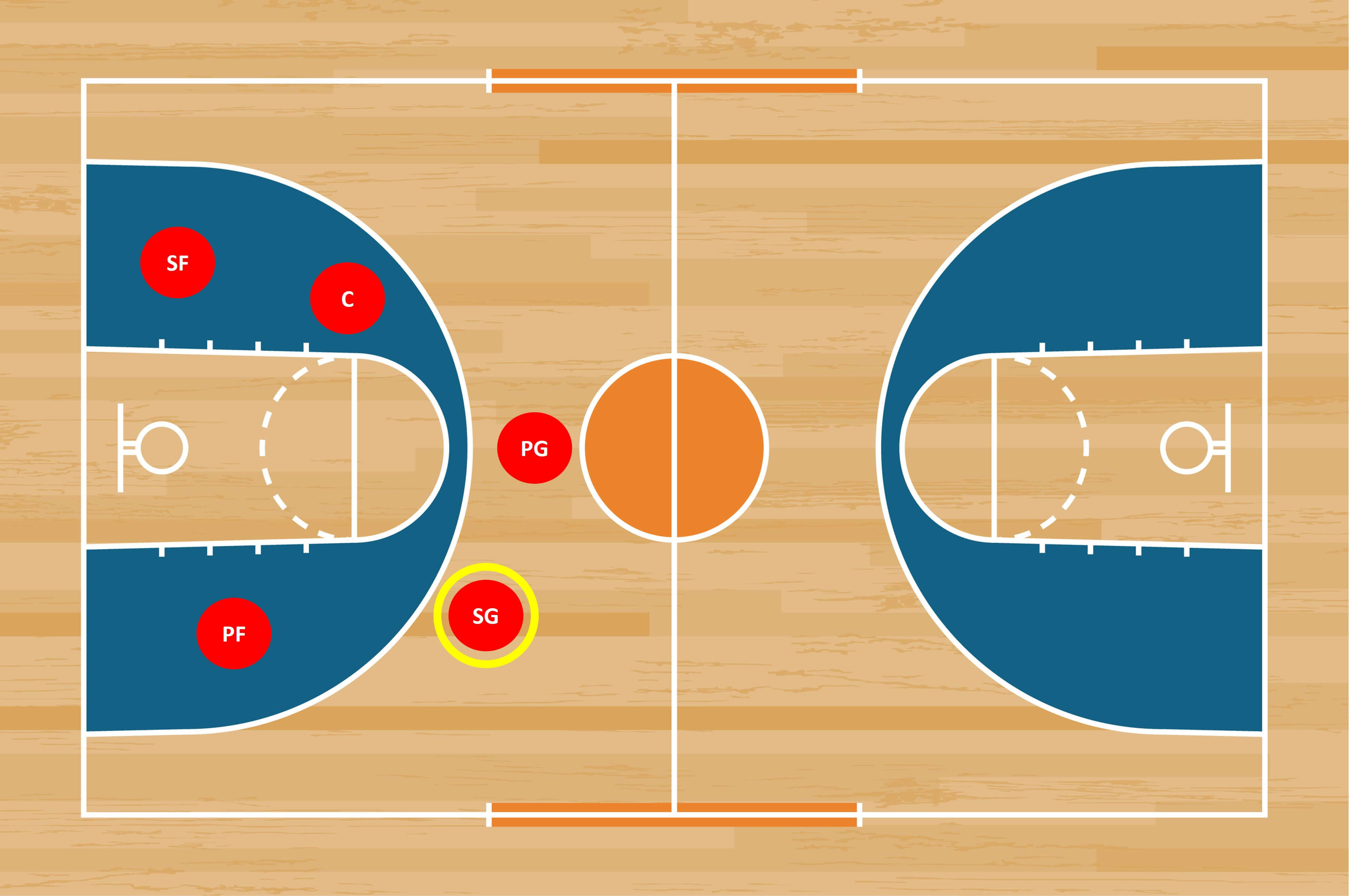 Stationed on the wing, the SG is the primary scorer. They excel at perimeter shooting,
driving to the basket, and creating opportunities.
The shooting guard (SG) is primarily responsible for scoring points, creating offensive opportunities, and defending perimeter players.
Role and Responsibilities
The shooting guard (SG) position on the basketball court is one of the five standard positions, often referred to as the "2" or "two-guard." SGs are primarily responsible for scoring points and can also play a role in playmaking and defense. They are expected to be effective from long range, mid-range, and close to the basket, making them a key offensive weapon. SGs also assist the point guard by handling the ball and helping to set up plays, and they are expected to guard the opposing team's best shooters or wing players on defense.
- Small Forward (SF)
-
 A versatile player who operates around the baseline and wing. The SF can score inside and outside,
defend multiple positions, and is often the most athletic player.
The small forward position is one of the most versatile roles on the basketball court. Small forwards are expected to contribute in multiple areas—scoring, defending, rebounding, and playmaking—making their skill set broad and adaptable. They must be able to handle the ball, shoot from various ranges, defend multiple positions, and create opportunities for their teammates. Understanding the responsibilities and skills required will help you become an effective small forward. Whether you want to improve your game or better grasp team dynamics, knowing what this position demands will give you a solid foundation to build on.
- Power Forward (PF)
-
 Positioned near the paint, the PF is a strong rebounder and inside scorer. They battle under the basket
but also stretch defenses with mid-range shots.
The power forward (PF) is a crucial position in basketball, responsible for rebounding, scoring, and playing defense near the basket. Power forwards typically stand between 6'8" and 6'10" and are known for their physicality, strength, and agility. They play a key role in both offensive and defensive strategies, often setting screens and protecting the paint. The PF's ability to score through various methods, such as post moves and mid-range jumpers, is essential for team success.
- Center (C)
-
 Anchored close to the rim, the center dominates rebounds, blocks shots, and scores in the low post.
They protect the paint and anchor the defense.
The center position in basketball is one of the five traditional playing positions on a team. Typically, the center is positioned near the baseline or low post, close to the basket. This player is often one of the tallest members of the team and plays a crucial part in both offensive and defensive aspects of the game. Responsibilities of the Center Position include:
- Rebounding: Securing missed shots on both the offensive and defensive ends of the court.
- Scoring in the Paint: Using their height and physicality to score through dunks, layups, and hook shots.
- Shot Blocking: Using their shot-blocking abilities to reject or alter opponents’ shots.
- Setting Screens: Creating obstacles for defenders to free up teammates for shots or drives to the basket.
- Passing: While not always the primary playmaker, centers are expected to have decent passing skills.
1
The center position is a unique role that requires a combination of physical skills, mental toughness, and strategic thinking. With the right training and focus, any aspiring player can elevate their game and become a dominant force in the center position.
