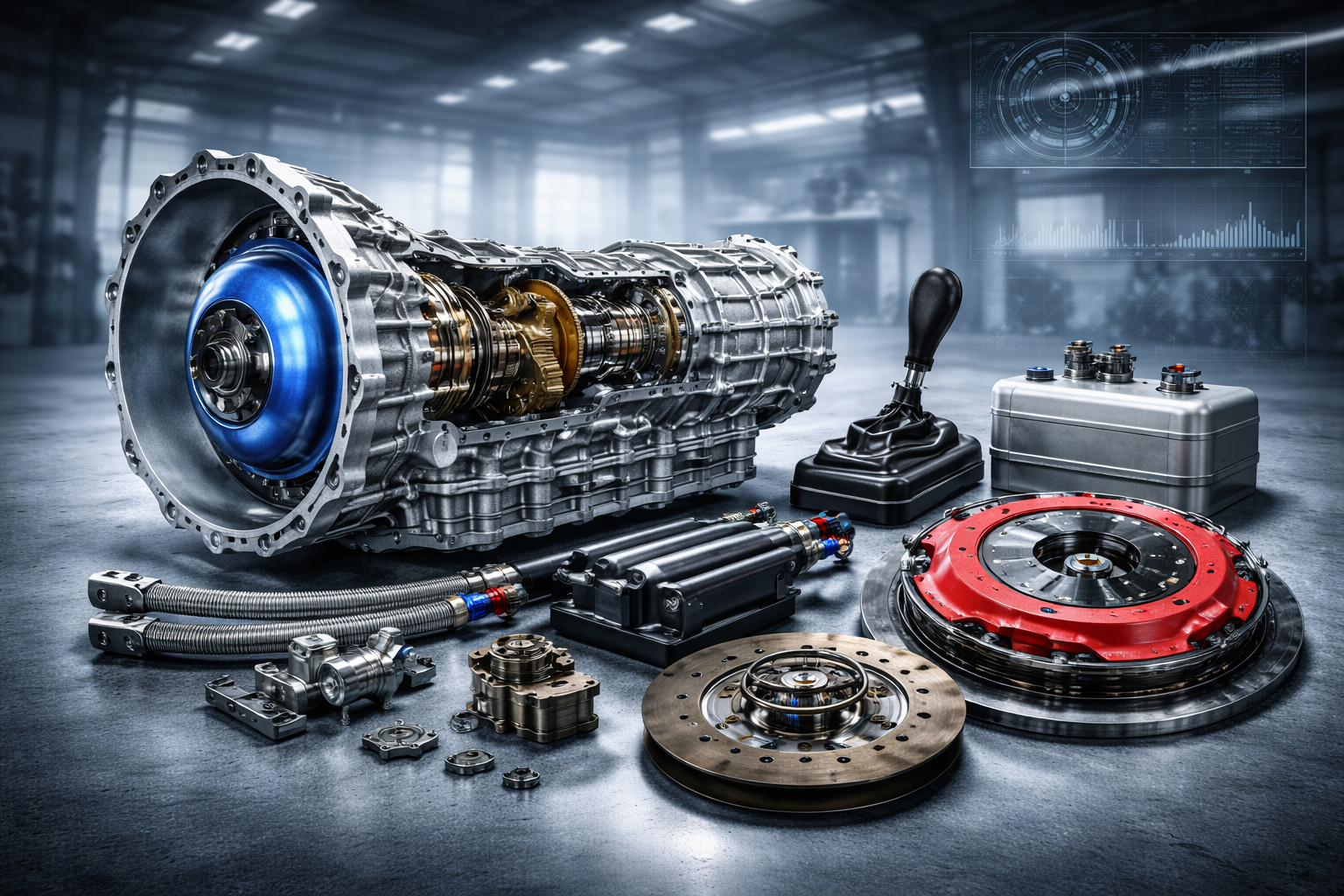
| Image | Type | Definition | Key Features | Advantages | Disadvantages |
|---|---|---|---|---|---|
 |
Manual | Driver manually changes gears using a clutch and gear stick | Clutch pedal, gear lever | Fuel efficient, more control | Harder to learn, tiring in traffic |
|
Automatic | Transmission automatically shifts gears without driver input | No clutch, smooth shifting | Easy to drive, comfortable | More expensive, less efficient |
|
CVT | Uses a belt and pulley system with no fixed gear ratios | Continuous gear variation | Smooth ride, fuel efficient | Less power feel, costly repairs |
|
DCT | Uses two clutches for faster gear shifting | Dual clutch system | Fast, high performance | Complex, expensive maintenance |
|
Semi-Automatic | Driver shifts gears without using a clutch | Paddle shifters | More control than automatic | Can be less smooth |
|
AMT | Manual transmission controlled automatically | No clutch pedal | Affordable, fuel efficient | Slower gear shifts |
A brake is a mechanical system designed to slow down, control, or completely stop the motion of a vehicle by applying resistance to its moving parts, usually through friction. It is one of the most essential safety components in any automobile, as it allows the driver to regulate speed and respond effectively to different road conditions, obstacles, and traffic situations. When the brake pedal is pressed, force is transmitted through the braking system(often using hydraulic pressure)to activate components such as brake pads and discs or drums. These components press against each other, creating friction that reduces the rotation of the wheels and gradually brings the vehicle to a stop. Beyond simply stopping the car, brakes play a crucial role in maintaining control, especially when driving at high speeds, going downhill, or navigating sharp turns. They also help prevent accidents by enabling quick and reliable responses in emergency situations. Modern braking systems are designed to be efficient and responsive, often including advanced features that improve stability and performance. Overall, the brake system is vital for safe driving, as it ensures that the vehicle can be controlled smoothly and stopped whenever necessary, protecting both the occupants and other road users.